
Edit
Salve Maria, a premier study abroad consultancy in Kerala, has a dedicated team from diverse backgrounds that envisions providing honest, transparent, and efficient services to our clients.
For most students in India, studying abroad is a significant financial and emotional investment. It isn’t just about getting a degree. It’s about the professional journey that begins the day after graduation. The central questions are always: Can you stay? Can you work? Can you build a career that justifies the tuition fees?
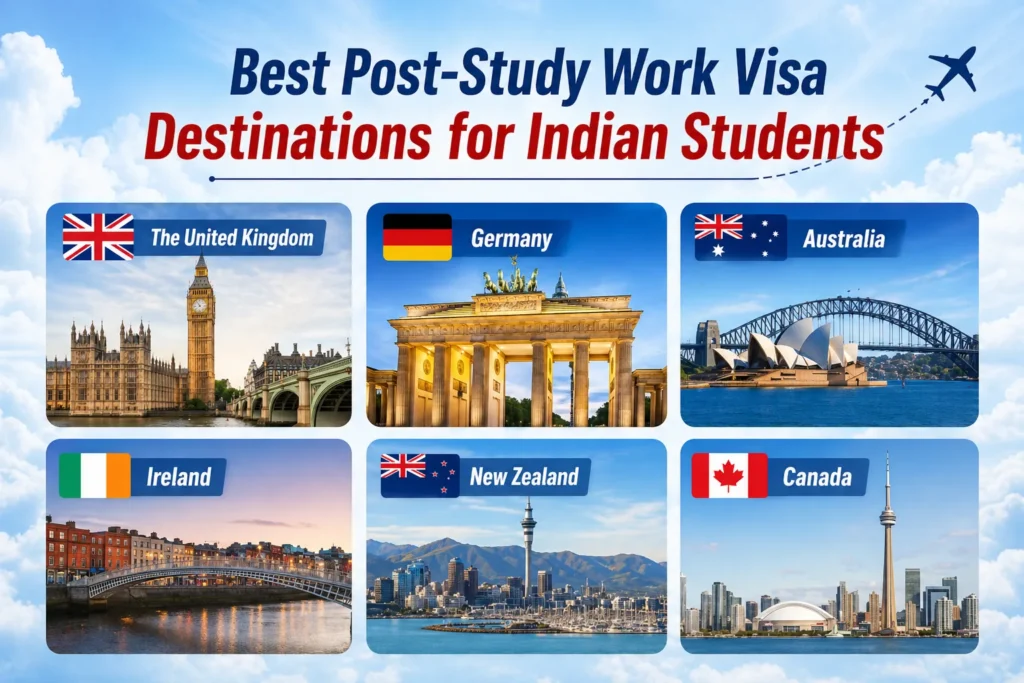
This is where the Post-Study Work Visa (PSW) becomes the most critical part of your planning. As a consultancy that has guided students across Kerala for nearly two decades, we have seen how a well-chosen work permit can change a student’s life. These visas offer the legal support needed to move from a learner to a professional, helping you recover costs and gain international experience. While immigration policies change often, we have pinpointed the top countries offering post-study work visas and how they can shape your global career. These locations provide the most reliable paths for students wanting to turn an international education into a global career.

The UK is still a top choice for students planning to study in the UK because of its Graduate Route, which is one of the simplest systems available. If you earn a Bachelor’s or Master’s degree, you can stay and work for 1.5 years. The biggest benefit is that you don’t need a job offer to apply. This gives you the freedom to take your time finding a role that suits your skills instead of hurrying into the first job you find. You can work in any field, easily switch employers, and even start your own business, making this a very flexible step toward a long-term career. Since the UK is home to some of the world’s most famous financial and tech hubs, this period is often the perfect window to build a network that lasts a lifetime.
If your interests lie in STEM (Science, Technology, Engineering, or Math), Germany is practically unbeatable. While learning the language is a hurdle, the professional rewards are immense. Upon graduation, Germany grants you an 18-month job-seeker visa. Unlike many other nations, Germany allows you to work without strict hour limits in any field during this period to support yourself while you hunt for your dream job. Once you secure a role related to your degree, the transition to a long-term Blue Card or work permit is seamless. With low tuition and a high demand for tech talent, Germany offers an incredible return on investment.
Australia is currently putting a lot of effort into filling critical skill gaps. This makes it a great place for engineers, healthcare workers, and IT professionals. Under the Subclass 500 visa, Bachelor’s graduates usually get 2 years, while Master’s graduates get 3 years. A special benefit in Australia is the Regional Bonus. If you study in designated regional areas, such as growing hubs like Adelaide or Perth, you can often apply for an extra 1 or 2 years of stay. With some of the highest minimum wages in the world, Australia is an excellent choice for students who want to repay education loans quickly while enjoying a high quality of life.
Ireland has become the Tech Capital of Europe. It is home to the European headquarters of major companies like Google, Apple, and Meta. For Indian students, its status as an English-speaking country and its friendly culture make the transition easier than in other parts of Europe. Under the Third Level Graduate Scheme, Master’s graduates can stay for two years after graduation, while Bachelor’s graduates get one year. The job market in Dublin and Cork is strong for those in data science, pharmaceuticals, and finance. This creates a good opportunity to start an international career without a language barrier.
New Zealand has become a more popular choice for students looking for a balanced lifestyle and good work opportunities after graduation. The Post-Study Work Visa allows graduates to stay and work for up to 3 years, depending on their qualification. One major advantage is that students do not need a job offer to apply, which gives them the freedom to explore different career options. The country has a rising demand in areas like healthcare, IT, engineering, and construction. With clear paths to residency for those in high-demand roles, along with a safe environment and a high quality of life, New Zealand is a great option for Indian students planning long-term careers abroad.
Canada has been a top choice for students who want to settle permanently. Its Post-Graduation Work Permit (PGWP) helps keep international talent. In 2026, the eligibility rules became more selective, with stricter requirements for certain institutions and programs. University degree holders usually have access, but eligibility now depends on the type of institution and program you choose. Typically, a two-year study program can lead to a work permit for up to three years. Canada also has a points-based system for Permanent Residency (PR). Having local work experience through the PGWP gives you a significant advantage. This makes Canada one of the most organized and trustworthy options for students who want to build a long-term future abroad.
Choosing a country based only on how many years it offers is a common mistake. You should look at the specific demand in your field. For instance, a mechanical engineer might have better long-term stability in Germany’s industrial sector, even if the UK has a slightly longer initial visa. Financial planning is also crucial. Some countries allow more part-time work hours during your studies to help pay rent and daily expenses, while others have stricter rules. Your success depends on aligning your academic path with the job market in your chosen destination. Taking the time to research and plan can make a significant difference in how smoothly your career progresses after graduation.
Navigating international immigration rules is a challenging task. These rules can change suddenly and have high stakes. A small mistake in a visa application or accidentally choosing a course that no longer qualifies for a work permit can lead to a rejection. This setback is more than just a delay. It goes on your permanent record and can make future travel or immigration efforts harder.
At Salve Maria, we have spent 19 years helping our students make the best choice among the top countries. With 10 dedicated branches across Kerala, we understand the specific challenges students face when going abroad. We create a clear plan to help you choose an academic path that matches your long-term goals. If you’re unsure which country is right for you or how to deal with the new 2026 visa rules, contact us. Let’s sit down and plan your journey together.
Preparing for the IELTS exam in just one month may seem challenging at first. But, given the proper approach, practice, and professional direction, it can be very attainable.
As an expert study abroad consultancy that has a history of almost 20 years of experience, we have assisted thousands of students in achieving their desired band scores. This guide provides a clear explanation of how to prepare in 30 days for IELTS and take a systematic and realistic approach.
The IELTS exam consists of four sections: listening, reading, writing, and speaking. Every section has a fixed time limit, a particular type of question, and a precise structure that you should adhere to in your test.
Understanding the format and timing of each section helps you to take the exam with confidence and make fewer mistakes. We will start with the listening section.
Note: In paper-based tests, you get an extra 10 minutes to transfer your answers. This time should be used carefully to avoid spelling mistakes. There are no negative marks, so it is always best to attempt every question.
Note: There are no negative marks, so it is always advisable to attempt every question.
To prepare for IELTS in 30 days, you must have a plan to do it every week. You need to work on all four sections of the IELTS from now on, every week. It is easier to monitor and stay focused on what you need to do to prepare for the exam
Week 1: Foundations & Assessment
Week 2: Intensive Skill Building
Week 3: Time Management and Mock Tests
Preparing for IELTS in one month requires a clear strategy, discipline and focus. You can slowly increase your overall score by learning how the test works and practising in all four areas: listening, reading, writing, and speaking. A regular mock test, good time management and a constant self-assessment of your mistakes are vital factors in getting your desired band score.
At Salve Maria, with a strong 19-year legacy and 10 branches across Kerala, we have guided thousands of students toward their study abroad goals, offering reliable IELTS training in Kerala. And in case you are still confused about how to prepare for IELTS in 30 days, the correct advice can help change everything. The knowledge and skills you gain with our professional training, individualised attention, and successful strategies will make you ready to score high and reach your goal.
Planning to study abroad is exciting—but it can also feel overwhelming. One of the best opportunities to get clarity, compare options, and fast-track your journey is by attending an education fair or delegate meet conducted by trusted consultancies like Salve Maria International.Stepping into a study abroad fair can feel like walking into a high-stakes global marketplace. Between the rows of university booths, the stacks of glossy brochures, and the buzz of “spot offers,” it’s easy to get overwhelmed.
However, these events are goldmines for information you won’t find on a website—if you show up prepared. Here is your ultimate guide to navigating education fairs and delegate meets in 2026.
But simply showing up isn’t enough. The students who benefit the most are the ones who come prepared.
Here’s your complete guide on what to do before, during, and after attending an education fair or meeting university delegates.
Don’t just “show up.” Treat this like a professional networking event.
While many fairs are digital-first, having physical copies makes you stand out as a serious candidate. Carry a neat folder containing:
You don’t need perfect English—but be ready to:
Confidence matters!!
Don’t waste time asking, “What is the ranking?”(you can Google that). Ask “insider” questions that help you gauge your fit:
Many delegates can:
This is something you won’t get online easily.
Education fairs often come with:
Don’t miss these exclusive benefits.
After meeting multiple universities, things can get confusing.
Write down:
You might discover:
Reach out to your counsellor or consultancy:
Timing matters—delays can cost you intakes.
Get ready with:
If you haven’t taken English tests:
Consultancies like Salve Maria International provide:
Use their expertise to avoid costly mistakes.
1) Attending without preparation
2) Not carrying documents
3) Asking vague questions
4) Ignoring deadlines
5) Delaying decisions after the event
An education fair or delegate meet is not just an event—it’s a gateway to your international future.These meets are not just about collecting information—they’re about building clarity and confidence in your study abroad journey. With preparation, active participation, and thoughtful follow-up, you can transform these events into stepping stones toward your global education dream.
.Pro-Tips for the Day
Dress the Part: You don’t need a suit, but Smart Casual is better than flip-flops. You are making a first impression on the people who might review your application.
Go Early: The first two hours are the best. Delegates are fresh, energized, and more likely to give you 10 minutes of undivided attention.
For nearly two decades, studying abroad for Indian students was dominated by a few traditional destinations. As we move this decade, the global education landscape has shifted. Countries like Canada face housing shortages, Australia has strict visa caps, and the UK is adjusting its immigration policies.
In this landscape, New Zealand stands out not merely as a scenic alternative but as a sophisticated, stable, and highly intentional choice for the serious scholar. Over the years, many students have followed this path firsthand. Its universities combine strong academics with career-focused opportunities, emphasizing professional growth over just earning a diploma.
One of the most common misconceptions about New Zealand is that it is smaller and therefore offers fewer options. In reality, New Zealand’s strength lies in its regulated quality. The New Zealand Qualifications Framework (NZQF) ensures that a Level 7 or Level 9 degree carries the same weight whether you are in Auckland or London.
Unlike countries with many private colleges of varying quality, New Zealand has consolidated vocational education under Te Pukenga. It integrates 16 institutes of technology and polytechnics into one national network. For a student from Kerala, this means your curriculum is tied directly to the national labor market. If you are studying Cybersecurity or Construction Management, you could be working on projects that the New Zealand government has identified as critical infrastructure needs.
The most vital piece of research any prospective student needs to do involves the Green List. New Zealand’s immigration strategy is refreshingly transparent compared to its peers. They don’t hide what they need. As of 2026, the Green List includes jobs that can help you fast-track residency. For students planning to study in New Zealand, aligning your course with these in-demand roles can significantly improve your long-term career and migration prospects. Key areas in demand are:
When you choose a course on the Green List, you are not just choosing a subject. In fact, you are choosing a career with a pre-defined legal pathway for staying in the country. This level of clarity is a luxury in the current international education climate.
While Auckland remains a vibrant global hub, the smartest moves are happening in New Zealand’s regional centers. Cities like Christchurch, Hamilton, and Dunedin offer something Tier 1 cities in other countries can no longer provide: an affordable, high-quality life.
The cost of living is a major factor for Kerala families. By choosing a regional university or polytechnic, students often find that part-time work covers a larger portion of their expenses. Regional employers are also more eager to retain international talent, leading to stronger networking opportunities and a faster transition into full-time roles post-graduation.
Let’s talk about cost benefits. Many students wonder why New Zealand is a preferred destination, especially given the strong return on investment (ROI) through the Post-Study Work Visa (PSWV). While it is not the cheapest destination, it is a premium education provider. However, the ROI becomes clear when factoring in post-study work opportunities.
A Master’s degree typically allows for a three-year open work visa. With a minimum wage of about NZD 22 per hour and strong demand in skilled fields, graduates can often recover their entire tuition investment within 18 to 24 months of full-time work.
Living costs differ by city, but students in regional areas can expect to spend around NZD 1,500 to 2,000 per month on rent, food, and transport. This blend of reasonable living costs, high wages, and PSWV makes New Zealand a budget-friendly option for international students.
Students from Kerala often feel at home in New Zealand. Both cultures value community, respect for nature, and a disciplined approach to learning. Unlike the hustle-driven pace of New York or the strict routines in some European cities, New Zealand promotes a flexible lifestyle that balances study, work, and personal life.
International students often comment on the accessibility of their professors. In a New Zealand university, you are likely to have coffee with your lecturer or work in small groups of 15–20 people. This close interaction accelerates learning and helps in building the professional references needed for that first job.
Immigration New Zealand is now more careful when checking “Bona Fide” students. Easy approvals through unverified channels are no longer possible. So, the focus is on the Statement of Purpose (SOP) and financial credibility.
The authorities want to see a clear path. If you have a background in Commerce and suddenly apply for a course in Hospitality without a good reason, it looks suspicious. They want students who have a real plan to help the New Zealand economy. This is where professional guidance becomes the difference between approval and rejection. You need to tell your story in a way that aligns your personal ambitions with New Zealand’s national interests.
If you plan to join the 2026 intake, begin early. Preparing your documents and understanding the process now will make your application smoother. New Zealand has two main intakes: February and July. Planning can save time and lower stress.
Choosing where to study and build your career is an important decision. At Salve Maria, we provide expert guidance, drawing on 19 years of experience and 10 branches across Kerala, including Trivandrum, Thiruvalla, Thodupuzha, Calicut, and more. We understand New Zealand’s education system and help you plan a future that extends beyond graduation.
From your first counseling session in Kerala to arriving in Wellington or Auckland, our team offers trusted advice based on two decades of experience. With the right guidance, you can make informed choices that align with both your academic and career goals. New Zealand welcomes those ready to work hard and join a global community. Contact your nearest Salve Maria branch today to start planning your journey.
Finland is turning out to be one of the most sought-after destinations for international students in Europe. It has a strong education system, a safe country, and progressive industries, which make it a great place to learn.
In the past few years, many students have started looking at Finland as a great place to pursue their studies, especially those from the state of Kerala in India. It has many master’s programs and universities where students can pursue their education because of the focus on research, technology, and sustainability.
The education system of Finland is considered one of the best in the world. However, it is not just the education system that makes Finland special, but the balance it provides with the quality of life.
Here are the key reasons for international students to choose Finland for their academic needs:
For students who need a tranquil atmosphere for studying with international exposure, Finland is the best place.

Aalto University has been widely known as one of the most innovative universities in Finland. It is situated in Espoo, which is a part of the Helsinki metropolitan region, making it an excellent destination for students who want to study in Finland, where technology, business, and creative worlds are united in a special manner.
Key highlights
Popular study areas include:
Aalto is particularly attractive for students interested in entrepreneurship, technology innovation, and global business.
The Finnish University of Helsinki is the oldest and largest university in Finland, and it has been featured in world university rankings on multiple occasions. It is based in the capital city and provides a powerful academic atmosphere to the students with an interest in some research and a higher level of education.
Academic strengths include:
Students who plan to pursue research careers, PhD programs, or work in international organizations often find the University of Helsinki to be a strong academic pathway.
The LUT University has become internationally known due to its attention to sustainability, clean energy, and technology innovation. LUT has some specialized programs to offer to students who are interested in the future of sustainable industries.
What makes LUT unique?
Popular fields include:
Tampere University is located in one of Finland’s most vibrant student cities. The university combines strong technical education with research in social sciences and health technology.
Major areas of study include:
Tampere is also known for its active student life and international student community, making it a popular choice for those looking for both academic and cultural experiences.
The University of Turku is a multi-disciplinary research university based in Turku, a seaport city. The institution has good research conditions and several master’s programs that are taught in English.
Key strengths
Turku is a mid-sized city with a lively student culture, historic surroundings, and strong academic traditions.
Located in northern Finland, the University of Oulu has developed an international reputation in technology and telecommunications.
Specializations include:
Oulu’s strong collaboration with global tech companies makes it a great choice for students who want careers in software development, telecom, and high-tech industries.
Hanken School of Economics is one of Finland’s leading business schools with campuses in Helsinki and Vaasa.
Why students choose Hanken
Graduates from Hanken often find employment quickly due to the university’s strong corporate connections.
In addition to research universities, Finland also offers Universities of Applied Sciences (UAS). These institutions focus more on practical learning and industry-oriented education.
Some well-known options include:
These universities emphasize:
They are a good choice for students who want a more practical and career-focused education.
International students may also be interested in the cost of studies in Finland as well as the availability of scholarships.
The following are some of the essential points to note:
Language
Tuition Fees
Scholarships
In Finland, many of the universities offer scholarships to students on the basis of academic performance.
The scholarships may be in the form of:
The students with excellent academic performance may have a higher probability of receiving scholarships.
With so many good universities, the key is to choose the right one depending on your academic and career objectives.
The factors that need to be considered while making the selection are as follows:
A well-planned application increases the chances of admission as well as scholarship.
The decision of which university to attend and how to apply for it is a daunting task. Whether it is the programs offered or the visa formalities, every step of the process requires careful planning.
With almost 20 years of experience behind us as a resource for students in Kerala and all across India, Salve Maria has been a contributing factor in the success of thousands of students in commencing their educational journey in a foreign environment.
If you are looking to pursue your educational journey in Finland and are looking for expert guidance to make the right decisions for you, then you can rely on the experts at Salve Maria for assistance.