Month: April 2026

For most students in India, studying abroad is a significant financial and emotional investment. It isn’t just about getting a degree. It’s about the professional journey that begins the day after graduation. The central questions are always: Can you stay? Can you work? Can you build a career that justifies the tuition fees?
This is where the Post-Study Work Visa (PSW) becomes the most critical part of your planning. As a consultancy that has guided students across Kerala for nearly two decades, we have seen how a well-chosen work permit can change a student’s life. These visas offer the legal support needed to move from a learner to a professional, helping you recover costs and gain international experience. While immigration policies change often, we have pinpointed the top countries offering post-study work visas and how they can shape your global career. These locations provide the most reliable paths for students wanting to turn an international education into a global career.
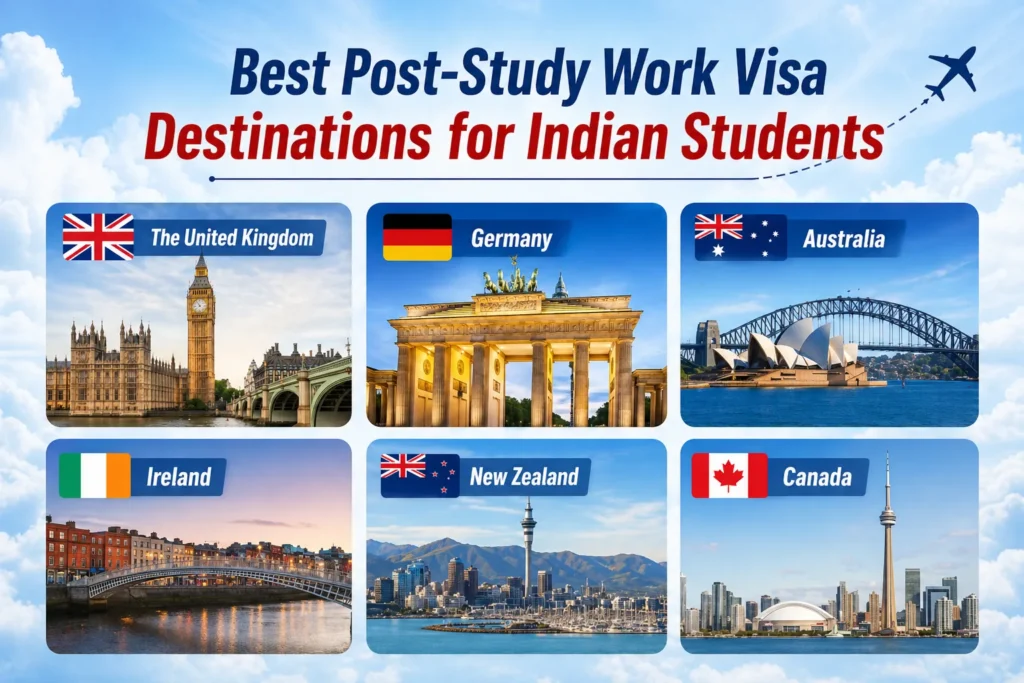
The United Kingdom
The UK is still a top choice for students planning to study in the UK because of its Graduate Route, which is one of the simplest systems available. If you earn a Bachelor’s or Master’s degree, you can stay and work for 1.5 years. The biggest benefit is that you don’t need a job offer to apply. This gives you the freedom to take your time finding a role that suits your skills instead of hurrying into the first job you find. You can work in any field, easily switch employers, and even start your own business, making this a very flexible step toward a long-term career. Since the UK is home to some of the world’s most famous financial and tech hubs, this period is often the perfect window to build a network that lasts a lifetime.
Germany
If your interests lie in STEM (Science, Technology, Engineering, or Math), Germany is practically unbeatable. While learning the language is a hurdle, the professional rewards are immense. Upon graduation, Germany grants you an 18-month job-seeker visa. Unlike many other nations, Germany allows you to work without strict hour limits in any field during this period to support yourself while you hunt for your dream job. Once you secure a role related to your degree, the transition to a long-term Blue Card or work permit is seamless. With low tuition and a high demand for tech talent, Germany offers an incredible return on investment.
Australia
Australia is currently putting a lot of effort into filling critical skill gaps. This makes it a great place for engineers, healthcare workers, and IT professionals. Under the Subclass 500 visa, Bachelor’s graduates usually get 2 years, while Master’s graduates get 3 years. A special benefit in Australia is the Regional Bonus. If you study in designated regional areas, such as growing hubs like Adelaide or Perth, you can often apply for an extra 1 or 2 years of stay. With some of the highest minimum wages in the world, Australia is an excellent choice for students who want to repay education loans quickly while enjoying a high quality of life.
Ireland
Ireland has become the Tech Capital of Europe. It is home to the European headquarters of major companies like Google, Apple, and Meta. For Indian students, its status as an English-speaking country and its friendly culture make the transition easier than in other parts of Europe. Under the Third Level Graduate Scheme, Master’s graduates can stay for two years after graduation, while Bachelor’s graduates get one year. The job market in Dublin and Cork is strong for those in data science, pharmaceuticals, and finance. This creates a good opportunity to start an international career without a language barrier.
New Zealand
New Zealand has become a more popular choice for students looking for a balanced lifestyle and good work opportunities after graduation. The Post-Study Work Visa allows graduates to stay and work for up to 3 years, depending on their qualification. One major advantage is that students do not need a job offer to apply, which gives them the freedom to explore different career options. The country has a rising demand in areas like healthcare, IT, engineering, and construction. With clear paths to residency for those in high-demand roles, along with a safe environment and a high quality of life, New Zealand is a great option for Indian students planning long-term careers abroad.
Canada
Canada has been a top choice for students who want to settle permanently. Its Post-Graduation Work Permit (PGWP) helps keep international talent. In 2026, the eligibility rules became more selective, with stricter requirements for certain institutions and programs. University degree holders usually have access, but eligibility now depends on the type of institution and program you choose. Typically, a two-year study program can lead to a work permit for up to three years. Canada also has a points-based system for Permanent Residency (PR). Having local work experience through the PGWP gives you a significant advantage. This makes Canada one of the most organized and trustworthy options for students who want to build a long-term future abroad.
Making the Right Move Requires the Right Guidance
Choosing a country based only on how many years it offers is a common mistake. You should look at the specific demand in your field. For instance, a mechanical engineer might have better long-term stability in Germany’s industrial sector, even if the UK has a slightly longer initial visa. Financial planning is also crucial. Some countries allow more part-time work hours during your studies to help pay rent and daily expenses, while others have stricter rules. Your success depends on aligning your academic path with the job market in your chosen destination. Taking the time to research and plan can make a significant difference in how smoothly your career progresses after graduation.
Your Trusted Partner for Studying Abroad – Salve Maria
Navigating international immigration rules is a challenging task. These rules can change suddenly and have high stakes. A small mistake in a visa application or accidentally choosing a course that no longer qualifies for a work permit can lead to a rejection. This setback is more than just a delay. It goes on your permanent record and can make future travel or immigration efforts harder.
At Salve Maria, we have spent 19 years helping our students make the best choice among the top countries. With 10 dedicated branches across Kerala, we understand the specific challenges students face when going abroad. We create a clear plan to help you choose an academic path that matches your long-term goals. If you’re unsure which country is right for you or how to deal with the new 2026 visa rules, contact us. Let’s sit down and plan your journey together.
Categories
How to Prepare for IELTS in 30 Days

Preparing for the IELTS exam in just one month may seem challenging at first. But, given the proper approach, practice, and professional direction, it can be very attainable.
As an expert study abroad consultancy that has a history of almost 20 years of experience, we have assisted thousands of students in achieving their desired band scores. This guide provides a clear explanation of how to prepare in 30 days for IELTS and take a systematic and realistic approach.
Understanding the IELTS Format
The IELTS exam consists of four sections: listening, reading, writing, and speaking. Every section has a fixed time limit, a particular type of question, and a precise structure that you should adhere to in your test.
Understanding the format and timing of each section helps you to take the exam with confidence and make fewer mistakes. We will start with the listening section.
1. Listening (30 minutes)
- Format: 4 sections with a total of 40 questions. Each section becomes progressively more challenging.
- Content: Four recordings, including conversations and monologues. These recordings are played only once, so attention is very important.
- Task Types: Multiple choice, matching, map or diagram labelling, and form or table completion. Each question tests your ability to capture specific details.
Note: In paper-based tests, you get an extra 10 minutes to transfer your answers. This time should be used carefully to avoid spelling mistakes. There are no negative marks, so it is always best to attempt every question.
2. Reading (60 minutes)
- Style: 3 passages containing 40 questions. Every passage must be attentively read and comprehended.
- Content
- Academic: It consists of long and complicated texts that are taken from academic materials. These are the passages that check your comprehension of the detailed information.
- General Training: This section involves daily texts, such as newspapers and magazines. These are realistic and practical and founded on real-life scenarios.
- Practice: You should practice skimming to identify the main ideas and scanning to find a particular detail. Scoring well also requires that one understands the arguments and opinions.
Note: There are no negative marks, so it is always advisable to attempt every question.
3. Writing (60 minutes)
- Style: Two tasks that must be written in an organised way and with logical presentation of ideas. These are both tasks that should be completed within the given time.
- Task 1 (20 minutes):
- Academic candidates describe visual data based on different types of graphs. This involves identifying key trends, comparing information, and presenting data clearly and accurately.
- General training candidates prepare a letter depending on the situation. The letter’s tone and format must be in accordance with the letter’s purpose.
- Task 2 (40 minutes):
- Write an essay with a minimum of 250 words. This task carries more marks, and hence, more attention and planning are needed.
- Note: Task 2 is worth 2 times as much as Task 1. It is thus important that you use your time well and write quality.
4. Speaking (11–14 minutes)
- Format: A face-to-face interview with an examiner. This part will test your ability in communication using the English language.
- Part 1: Introduction and general questions about familiar topics. This section assists the examiner in understanding your basic communication skills.
- Part 2: You are going to receive a cue card and speak on a topic. One minute to prepare and then speak up to two minutes.
- Part 3: The discussion related to Part 2. This section tests your ability to express and justify opinions clearly.
Creating an IELTS Study Plan for 1 Month
To prepare for IELTS in 30 days, you must have a plan to do it every week. You need to work on all four sections of the IELTS from now on, every week. It is easier to monitor and stay focused on what you need to do to prepare for the exam
Week 1: Foundations & Assessment
- Understand the Format: Take time and learn every part of the test. This makes you feel more confident before starting practice.
- Take a Diagnostic Test: A full-length mock test helps you to identify your current level. Such an exercise makes you understand your weaknesses and strengths well.
- Create Daily Routines: Start reading English newspapers and listening to English podcasts for a day. Such practice improves vocabulary and helps you get used to natural language use.
Week 2: Intensive Skill Building
- Reading & Listening: Train to use skimming and scanning as often as possible. Also, improve the note-taking to record key information in a short period of time.
- Writing: Pay attention to the task structure and clarity of ideas. Practice Task 1 and Task 2 on a daily basis to become better at consistency and accuracy.
- Speaking: Practice common IELTS topics and record your answers. This exercise allows you to improve your fluency and pinpoint specific areas where you could do better.
Week 3: Time Management and Mock Tests
- Practice: Start practising reading and writing with strict time constraints. This will help in accelerating the process and reducing pressure.
- Full-Length Tests: It is recommended to give at least two full-length tests in a week. This will help in building endurance and getting you used to the actual exam.
- Review Mistakes: Review your mistakes after each test. It is not important to review your scores, but it is important to review your mistakes.
Week 4: Final Polish
- Target Weak Areas: Concentrate on those areas where you are losing marks. This will give you the maximum benefit in a short time.
- Simulate Exam Day: Take 1-2 full-length tests in a quiet environment. This will familiarise you with the exam day.
- Use Feedback: Get your writing and speaking tested by experts. This will give you the final boost before the exam.
Additional Tips for Success
- Stay Consistent: Be consistent with a plan of studying daily. It is better to practice regularly than to learn randomly.
- Improve Vocabulary Naturally: Improve vocabulary by reading and listening. These exercises will assist you in applying them in real situations.
- Work with Real Materials: Practice with real IELTS questions from trusted sources. This guarantees improved familiarity with the exam pattern.
- Grammar: Pay attention to the structure and correctness of sentences. Good grammar enhances the score in writing and speaking.
- Stay Calm: Do not be negative during your preparation. Trust is an influential part of performance.
Common Mistakes to Avoid
- Breaking Time Rules: It is possible to practice without time limits, and this approach will influence your results in the actual exam. Always practice exam conditions.
- Memorising Answers: It is better to understand concepts other than to memorise answers. This assists you in dealing with the unexpected questions.
- Neglecting Speaking Practice: Speaking frequently is a prerequisite to building fluency. This is one part that should not be left out during preparation.
- Not Reviewing Mistakes: Learning by mistake will enable you to learn better. Always analyse what has gone wrong and the way to rectify it.
Success Starts with Smart Preparation
Preparing for IELTS in one month requires a clear strategy, discipline and focus. You can slowly increase your overall score by learning how the test works and practising in all four areas: listening, reading, writing, and speaking. A regular mock test, good time management and a constant self-assessment of your mistakes are vital factors in getting your desired band score.
At Salve Maria, with a strong 19-year legacy and 10 branches across Kerala, we have guided thousands of students toward their study abroad goals, offering reliable IELTS training in Kerala. And in case you are still confused about how to prepare for IELTS in 30 days, the correct advice can help change everything. The knowledge and skills you gain with our professional training, individualised attention, and successful strategies will make you ready to score high and reach your goal.
Planning to study abroad is exciting—but it can also feel overwhelming. One of the best opportunities to get clarity, compare options, and fast-track your journey is by attending an education fair or delegate meet conducted by trusted consultancies like Salve Maria International.Stepping into a study abroad fair can feel like walking into a high-stakes global marketplace. Between the rows of university booths, the stacks of glossy brochures, and the buzz of “spot offers,” it’s easy to get overwhelmed.
However, these events are goldmines for information you won’t find on a website—if you show up prepared. Here is your ultimate guide to navigating education fairs and delegate meets in 2026.
But simply showing up isn’t enough. The students who benefit the most are the ones who come prepared.
Here’s your complete guide on what to do before, during, and after attending an education fair or meeting university delegates.
BEFORE THE EVENT: PREPARATION IS EVERYTHING
1. Define Your Goal
Don’t just “show up.” Treat this like a professional networking event.
- Target List: Most consultancies release a list of attending universities a few days prior. Pick 5–7 “Must-Visits” and 3 “Wildcards” (new destinations or unique programs).
- Know Your Stats: Memorize your current CGPA, latest IELTS/PTE scores, and your budget. Delegates hate vague answers like “I’m not sure of my grades yet.”
- Engage Actively
Don’t just collect brochures—talk to university representatives and delegates. Ask about campus life, career support, and alumni success stories. - Many fairs include sessions on visas, scholarships, and Bank Loans. These are invaluable for understanding the bigger picture.This ensures your conversations are focused and productive.
2. Prepare Your Documents
While many fairs are digital-first, having physical copies makes you stand out as a serious candidate. Carry a neat folder containing:
- Academic Transcripts: Photocopies of your 10th, 12th, and Semester-wise Degree mark sheets.
- Updated Resume: A clean, 1-page CV highlighting internships or projects.
- Test Scores: A copy of your IELTS/TOEFL/PTE or GRE/GMAT score report.
- Identity: A copy of your Passport (first and last page).
- Notebook & Pen: (Or a dedicated note-taking app) to jot down specific advice given by the delegates.
3. Work on Basic Communication
You don’t need perfect English—but be ready to:
- Introduce yourself
- Talk about your academic background
- Explain your future goals
Confidence matters!!
THINGS TO REMEMBER AT THE FAIR
1. Approach Delegates Confidently
Don’t waste time asking, “What is the ranking?”(you can Google that). Ask “insider” questions that help you gauge your fit:
- The Reality Check: “Based on my profile, what are my realistic chances for a scholarship?”
- The Outcome: “What industries do your international graduates usually end up in?”
- The Logistics: “Is on-campus accommodation guaranteed for first-year international students?”
2. Get Your Profile Evaluated
Many delegates can:
- Assess your eligibility instantly
- Suggest the best-fit courses
- Recommend alternative options
This is something you won’t get online easily.
3. Ask About Scholarships & Offers
Education fairs often come with:
- Application fee waivers
- Scholarships
- Fast-track admissions
Don’t miss these exclusive benefits.
4. Take Notes & Collect Details
After meeting multiple universities, things can get confusing.
Write down:
- Course names
- Deadlines
- Requirements
- Key advantages
5. Stay Open-Minded
You might discover:
- Better countries than your initial choice
- Courses with stronger career outcomes
AFTER THE EVENT: TURN ACTION INTO RESULTS
1. Follow Up Immediately
Reach out to your counsellor or consultancy:
- Confirm shortlisted universities
- Begin application process
Timing matters—delays can cost you intakes.
2. Organize Your Documents
Get ready with:
- SOP (Statement of Purpose)
- LOR (Letters of Recommendation)
- Financial documents
3. Start Test Preparation (If Needed)
If you haven’t taken English tests:
- Prepare for IELTS / PTE
- Book your test early
4. Trust Expert Guidance
Consultancies like Salve Maria International provide:
- University selection
- Application processing
- Visa guidance
- Test preparation
Use their expertise to avoid costly mistakes.
COMMON MISTAKES TO AVOID
1) Attending without preparation
2) Not carrying documents
3) Asking vague questions
4) Ignoring deadlines
5) Delaying decisions after the event
🌟 FINAL THOUGHT
An education fair or delegate meet is not just an event—it’s a gateway to your international future.These meets are not just about collecting information—they’re about building clarity and confidence in your study abroad journey. With preparation, active participation, and thoughtful follow-up, you can transform these events into stepping stones toward your global education dream.
.Pro-Tips for the Day
Dress the Part: You don’t need a suit, but Smart Casual is better than flip-flops. You are making a first impression on the people who might review your application.
Go Early: The first two hours are the best. Delegates are fresh, energized, and more likely to give you 10 minutes of undivided attention.