
Study Abroad :  +91 9142552887

Language Division : +91 9142552883

Edit

Salve Maria, a premier study abroad consultancy in Kerala, has a dedicated team from diverse backgrounds that envisions providing honest, transparent, and efficient services to our clients.

Categories
Blogs

Why Choose New Zealand for Higher Education?

For nearly two decades, studying abroad for Indian students was dominated by a few traditional destinations. As we move this decade, the global education landscape has shifted. Countries like Canada face housing shortages, Australia has strict visa caps, and the UK is adjusting its immigration policies.

In this landscape, New Zealand stands out not merely as a scenic alternative but as a sophisticated, stable, and highly intentional choice for the serious scholar. Over the years, many students have followed this path firsthand. Its universities combine strong academics with career-focused opportunities, emphasizing professional growth over just earning a diploma.

New Zealand’s Education System 

One of the most common misconceptions about New Zealand is that it is smaller and therefore offers fewer options. In reality, New Zealand’s strength lies in its regulated quality. The New Zealand Qualifications Framework (NZQF) ensures that a Level 7 or Level 9 degree carries the same weight whether you are in Auckland or London.

Unlike countries with many private colleges of varying quality, New Zealand has consolidated vocational education under Te Pukenga. It integrates 16 institutes of technology and polytechnics into one national network. For a student from Kerala, this means your curriculum is tied directly to the national labor market. If you are studying Cybersecurity or Construction Management, you could be working on projects that the New Zealand government has identified as critical infrastructure needs.

New Zealand Green List: In-Demand Careers and Residency Pathways

The most vital piece of research any prospective student needs to do involves the Green List. New Zealand’s immigration strategy is refreshingly transparent compared to its peers. They don’t hide what they need. As of 2026, the Green List includes jobs that can help you fast-track residency. For students planning to study in New Zealand, aligning your course with these in-demand roles can significantly improve your long-term career and migration prospects. Key areas in demand are:

  • Specialized ICT Professionals: Roles in AI ethics, data engineering, and cloud architecture.
  • Environmental Engineers: Jobs in green energy and sustainability are growing rapidly as New Zealand works toward its 2030 climate goals.
  • Healthcare Practitioners: Specialized roles in aged care and mental health are highly sought after.
  • Secondary Educators: With a growing population, there is a sustained need for STEM teachers.

When you choose a course on the Green List, you are not just choosing a subject. In fact, you are choosing a career with a pre-defined legal pathway for staying in the country. This level of clarity is a luxury in the current international education climate.

Opportunities in New Zealand’s Regional Cities

While Auckland remains a vibrant global hub, the smartest moves are happening in New Zealand’s regional centers. Cities like Christchurch, Hamilton, and Dunedin offer something Tier 1 cities in other countries can no longer provide: an affordable, high-quality life.

  • Christchurch is home to the University of Canterbury and the Ara Institute of Canterbury. Both schools have strong programs in engineering, IT, and applied sciences. 
  • Hamilton is where you will find Waikato University, recognized for its programs in business, law, and science. It also has Wintec, or the Waikato Institute of Technology, which offers vocational and applied courses. 
  • Dunedin is known for the University of Otago, the oldest university in New Zealand. It excels in health sciences, research, and humanities.

The cost of living is a major factor for Kerala families. By choosing a regional university or polytechnic, students often find that part-time work covers a larger portion of their expenses. Regional employers are also more eager to retain international talent, leading to stronger networking opportunities and a faster transition into full-time roles post-graduation.

Tuition Costs and Career Benefits in New Zealand

Let’s talk about cost benefits. Many students wonder why New Zealand is a preferred destination, especially given the strong return on investment (ROI) through the Post-Study Work Visa (PSWV). While it is not the cheapest destination, it is a premium education provider. However, the ROI becomes clear when factoring in post-study work opportunities.

  • Bachelor’s Degree (Level 7): NZD 22,000–32,000 per year
  • Master’s Degree (Level 9): NZD 26,000–37,000 per year
  • Postgraduate Diploma (Level 8): NZD 24,000 – 35,000 per year (same rates for international and domestic students)

A Master’s degree typically allows for a three-year open work visa. With a minimum wage of about NZD 22 per hour and strong demand in skilled fields, graduates can often recover their entire tuition investment within 18 to 24 months of full-time work.

Living costs differ by city, but students in regional areas can expect to spend around NZD 1,500 to 2,000 per month on rent, food, and transport. This blend of reasonable living costs, high wages, and PSWV makes New Zealand a budget-friendly option for international students.

Cultural and Academic Fit for Kerala Students

Students from Kerala often feel at home in New Zealand. Both cultures value community, respect for nature, and a disciplined approach to learning. Unlike the hustle-driven pace of New York or the strict routines in some European cities, New Zealand promotes a flexible lifestyle that balances study, work, and personal life.

International students often comment on the accessibility of their professors. In a New Zealand university, you are likely to have coffee with your lecturer or work in small groups of 15–20 people. This close interaction accelerates learning and helps in building the professional references needed for that first job.

Navigating New Zealand’s Student Visa Process

Immigration New Zealand is now more careful when checking “Bona Fide” students. Easy approvals through unverified channels are no longer possible. So, the focus is on the Statement of Purpose (SOP) and financial credibility.

The authorities want to see a clear path. If you have a background in Commerce and suddenly apply for a course in Hospitality without a good reason, it looks suspicious. They want students who have a real plan to help the New Zealand economy. This is where professional guidance becomes the difference between approval and rejection. You need to tell your story in a way that aligns your personal ambitions with New Zealand’s national interests.

Essential Steps for New Zealand Study Applicants

If you plan to join the 2026 intake, begin early. Preparing your documents and understanding the process now will make your application smoother. New Zealand has two main intakes: February and July. Planning can save time and lower stress.

  • Start Six Months Early: Begin your documentation at least six months before your intake. This includes your English proficiency tests (IELTS or PTE) and securing your proof of funds.
  • Focus on Level 8 and 9 Programs: While Level 7 (Bachelors) is great, the strongest work rights and residency pathways in the current climate are tied to postgraduate diplomas and master’s degrees.
  • Health and Police Checks: Ensure your health checks and police clearances are handled early, as these can sometimes slow down your application.

Expert Guidance for Studying in New Zealand

Choosing where to study and build your career is an important decision. At Salve Maria, we provide expert guidance, drawing on 19 years of experience and 10 branches across Kerala, including Trivandrum, Thiruvalla, Thodupuzha, Calicut, and more. We understand New Zealand’s education system and help you plan a future that extends beyond graduation.

From your first counseling session in Kerala to arriving in Wellington or Auckland, our team offers trusted advice based on two decades of experience. With the right guidance, you can make informed choices that align with both your academic and career goals. New Zealand welcomes those ready to work hard and join a global community. Contact your nearest Salve Maria branch today to start planning your journey.

Categories
Blogs

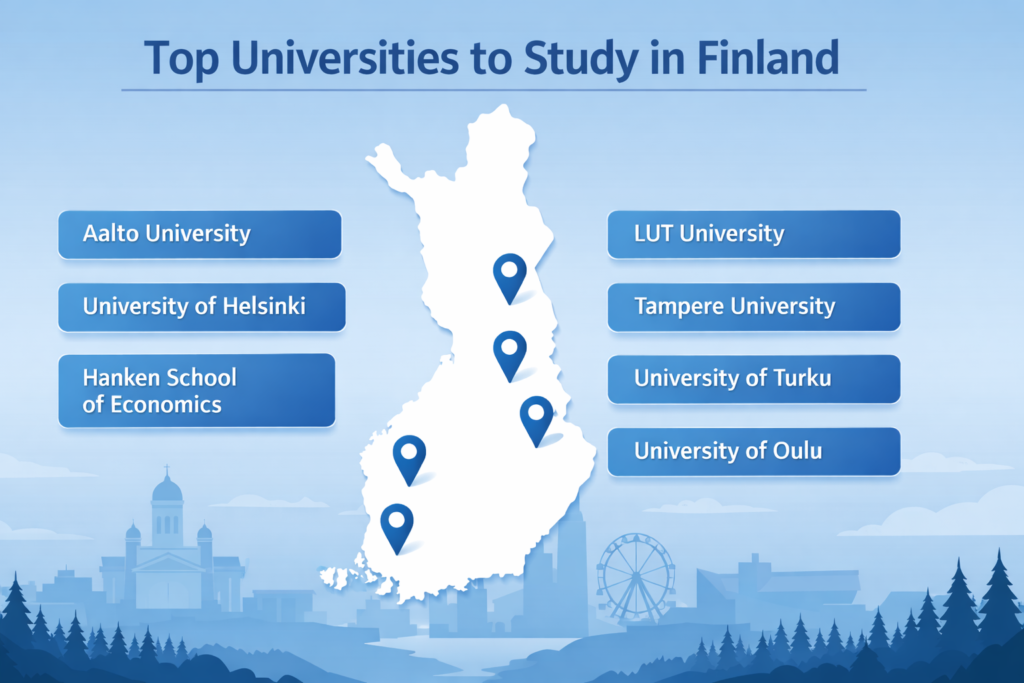
Top Universities in Finland for International Students

Finland is turning out to be one of the most sought-after destinations for international students in Europe. It has a strong education system, a safe country, and progressive industries, which make it a great place to learn.

In the past few years, many students have started looking at Finland as a great place to pursue their studies, especially those from the state of Kerala in India. It has many master’s programs and universities where students can pursue their education because of the focus on research, technology, and sustainability.

Why Study in Finland?

The education system of Finland is considered one of the best in the world. However, it is not just the education system that makes Finland special, but the balance it provides with the quality of life.

Here are the key reasons for international students to choose Finland for their academic needs:

  • World-class education institutions with state-of-the-art technology for research
  • Availability of numerous master’s programs taught in English, especially in the fields of technology, business, and sustainability
  • Clean and safe cities with good public transport systems
  • Strong industry-university links
  • Availability of internships and research opportunities

For students who need a tranquil atmosphere for studying with international exposure, Finland is the best place.

Popular Universities in Finland for Higher Education

Aalto University

Aalto University has been widely known as one of the most innovative universities in Finland. It is situated in Espoo, which is a part of the Helsinki metropolitan region, making it an excellent destination for students who want to study in Finland, where technology, business, and creative worlds are united in a special manner.

Key highlights

  • Strong programs in engineering, business, and design
  • A vibrant startup and innovation ecosystem
  • Modern campus with strong links to the Helsinki tech industry

Popular study areas include:

  • Computer science and electrical engineering
  • Mechanical engineering and technology
  • International business and management
  • Arts and design

Aalto is particularly attractive for students interested in entrepreneurship, technology innovation, and global business.

University of Helsinki

The Finnish University of Helsinki is the oldest and largest university in Finland, and it has been featured in world university rankings on multiple occasions. It is based in the capital city and provides a powerful academic atmosphere to the students with an interest in some research and a higher level of education.

Academic strengths include:

  • Life sciences and medicine
  • Natural sciences such as physics and chemistry
  • Social sciences and economics
  • Law, humanities, and education

Students who plan to pursue research careers, PhD programs, or work in international organizations often find the University of Helsinki to be a strong academic pathway.

LUT University 

The LUT University has become internationally known due to its attention to sustainability, clean energy, and technology innovation. LUT has some specialized programs to offer to students who are interested in the future of sustainable industries.

What makes LUT unique?

  • Strong focus on green technology and sustainability
  • Programs connected to the circular economy and clean energy transition
  • Close collaboration with industries through internships and projects

Popular fields include:

  • Sustainability science
  • Mechanical and industrial engineering
  • Energy technology
  • International business

Tampere University

Tampere University is located in one of Finland’s most vibrant student cities. The university combines strong technical education with research in social sciences and health technology.

Major areas of study include:

  • Information technology and software engineering
  • Health technology and biomedical research
  • Social sciences and education
  • Media and communication studies

Tampere is also known for its active student life and international student community, making it a popular choice for those looking for both academic and cultural experiences.

University of Turku

The University of Turku is a multi-disciplinary research university based in Turku, a seaport city. The institution has good research conditions and several master’s programs that are taught in English.

Key strengths

  • Biomedicine and health sciences
  • Dentistry and life sciences
  • Business and economics
  • Humanities and future studies

Turku is a mid-sized city with a lively student culture, historic surroundings, and strong academic traditions.

University of Oulu

Located in northern Finland, the University of Oulu has developed an international reputation in technology and telecommunications.

Specializations include:

  • Wireless communications and 5G technology
  • Computer science and ICT
  • Health sciences and biomedical engineering

Oulu’s strong collaboration with global tech companies makes it a great choice for students who want careers in software development, telecom, and high-tech industries.

Hanken School of Economics

Hanken School of Economics is one of Finland’s leading business schools with campuses in Helsinki and Vaasa.

Why students choose Hanken

  • Specialized focus on business and economics
  • Small class sizes and strong faculty interaction
  • Strong alumni network in Nordic and European markets

Graduates from Hanken often find employment quickly due to the university’s strong corporate connections.

Universities of Applied Sciences in Finland

In addition to research universities, Finland also offers Universities of Applied Sciences (UAS). These institutions focus more on practical learning and industry-oriented education.

Some well-known options include:

  • Lab University of Applied Sciences
  • Vaasa University of Applied Sciences
  • Diaconia University of Applied Sciences
  • Oulu University of Applied Sciences

These universities emphasize:

  • Hands-on training
  • internship opportunities
  • applied research projects

They are a good choice for students who want a more practical and career-focused education.

Tuition Fees, Scholarships, and Language

International students may also be interested in the cost of studies in Finland as well as the availability of scholarships.

The following are some of the essential points to note:

Language

  • The language of teaching in most of the master’s programs is English.
  • In some of the bachelor’s programs, the language of teaching may also be Finnish or Swedish.

Tuition Fees

  • For non-EU students, tuition fees may be applicable for English-taught programs.
  • The tuition fees may vary from university to university.

Scholarships

In Finland, many of the universities offer scholarships to students on the basis of academic performance.

The scholarships may be in the form of:

  • Partial tuition fee waivers
  • Full scholarships to cover tuition fees
  • Relocation grant for international master’s students

The students with excellent academic performance may have a higher probability of receiving scholarships.

How to Choose the Right University in Finland

With so many good universities, the key is to choose the right one depending on your academic and career objectives.

The factors that need to be considered while making the selection are as follows:

  • Academic Background: Select the academic programs that match your academic background.
  • Career Objectives: Research universities are good for academic careers, while applied universities are good for industry careers.
  • Location: Cities with larger populations provide more opportunities for networking, while smaller cities have lower living costs.
  • Scholarships: Consider the scholarship opportunities at the respective universities.

A well-planned application increases the chances of admission as well as scholarship.

Expert Guidance for Studying in Finland

The decision of which university to attend and how to apply for it is a daunting task. Whether it is the programs offered or the visa formalities, every step of the process requires careful planning.

With almost 20 years of experience behind us as a resource for students in Kerala and all across India, Salve Maria has been a contributing factor in the success of thousands of students in commencing their educational journey in a foreign environment.

If you are looking to pursue your educational journey in Finland and are looking for expert guidance to make the right decisions for you, then you can rely on the experts at Salve Maria for assistance.

Categories
Blogs

Why Choose France for  Master’s Studies

When students and parents approach us for international education counselling, the conversation often begins with familiar destinations. However, in the last ten years, France has become one of the top study destinations for international students seeking Master’s degrees. This change is not caused by trends or marketing hype. It comes from real benefits in education quality, cost, job outcomes, and global experience. 

From our 19 years of helping students in different fields and at various academic levels, we have observed how a Master’s degree in France can turn educational goals into long-term career success. This blog explains why choosing France as a study destination for Master’s programmes is a decision rooted in long-term value rather than short-term convenience.

A Higher Education System Built on Academic Excellence

The Higher Education System of France aims to reach high academic standards by combining historical intellectual traditions with modern teaching methods that meet professional needs. The system is constructed through three main components, which provide different levels of educational programs:

  • Public universities provide comprehensive educational services through a wide range of academic programs.
  • The elite Grandes Écoles prepare students for successful careers in business, engineering, public administration, and technology. 
  • Specialised schools offer focused master ’s-level training in areas such as fashion, culinary arts, architecture, and design.

French Master’s degrees are recognised around the world because they follow the European Bologna Process. The institutions maintain their reputation as top universities by offering solid Master’s programmes in business management, aerospace engineering, artificial intelligence, economics, and political science. France excels in academics because students experience thorough educational development.

Globally Competitive Education at an Affordable Cost

One of the main reasons students choose France for Master’s studies is its great balance between cost and quality. Unlike many popular English-speaking countries, France provides strong support for higher education, even for international students. Major financial benefits include:

  • Significantly lower tuition fees at public universities  
  • Clear and regulated fee structures  
  • Access to government and institutional scholarships  
  • Housing assistance programs that lower accommodation costs  
  • Affordable public transport, healthcare, and living expenses  

Families looking for affordable postgraduate education should consider France their best option. It provides great educational value at a fair price.

Wide Range of English-Taught Programmes

France offers several Master’s programmes taught in English. Language is a major concern for many students planning to study abroad. To address this issue, France has significantly increased its English-taught programmes, particularly at the Master’s and doctoral levels. Students can pursue Master’s degrees in:

  • Business and management  
  • Data science and artificial intelligence  
  • Engineering and technology  
  • International relations and public policy  
  • Hospitality, luxury brand management, and fashion  

While the academic instruction is in English, students are encouraged to develop their French. This bilingual exposure improves job prospects across Europe. Based on our experience, students who have strong technical skills with even basic French language skills tend to perform better and adapt more in global job markets.

Strong Industry Integration and Career Opportunities

French universities offer training through internships and partnerships with businesses. The country also permits international students to work part-time while earning their Master’s degree, helping them cover living costs and gain practical experience.

After completing their Master’s program, graduates can stay in France to search for jobs or start their own businesses through post-study work programs. Consultants say that students who earn their Master’s in France often have successful careers in Europe and beyond.

A Strategic Gateway to Europe

Students pursuing their Master’s degree in France experience both the country and the wider European landscape. The French student visa allows them to travel within Schengen countries for academic conferences, networking events, and internships.

This geographic and economic position provides major advantages. It helps international professionals build global networks and gain exposure to diverse work cultures across Europe. The European Union also provides career mobility between member countries and encourages collaboration in research and innovation. For ambitious Master’s students, France becomes a strong launchpad for international career opportunities.

Cultural Intelligence and Personal Development

Studying in France goes beyond classroom learning, especially in the Master’s stage. Here, students gain both academic knowledge and professional growth. The country’s intellectual environment helps students build:

  • Independence and adaptability
  • A global mindset is essential for leadership roles
  • Cross-cultural communication skills
  • Appreciation for diverse perspectives and lifestyles

French cities provide safe environments for students with active student communities and vibrant cultural life. This holistic experience is just as valuable as the academic qualification itself.

Strong Support System for International Students

France has built a well-structured international student support system supported by public funding. Universities provide dedicated international offices that help Master’s students with academic guidance, career planning, and settlement support. Students benefit from:

  • Access to public healthcare systems
  • Student welfare and social security coverage
  • Subsidised housing and dining facilities
  • Legal clarity regarding work rights and residence permits

This structured and student-centric environment reduces uncertainty and helps international Master’s students focus on their academic and professional development.

Research, Innovation and Future-Focused Learning

France is a global leader in research and development, making it an ideal destination for research-oriented Master’s programmes. Students benefit from access to:

  • Advanced laboratories and research centres
  • Government-funded innovation programmes
  • Collaboration with global research institutions
  • Doctoral and post-doctoral opportunities

Fields such as renewable energy, artificial intelligence, biotechnology, and space science continue to attract international research talent to France.

A Thoughtful Choice for Ambitious Students

When considering why to choose France for Master’s studies, the reasons include its strong academic quality, low cost, job prospects, and international experience all in one place. In short, France is not just an option like other traditional destinations.

At Salve Maria, we guide students through every stage of their journey to pursue a Master’s degree in France, from selecting the right institution and programme to securing visas, scholarships, and long-term career planning. Our consultancy approach is rooted in experience, transparency, and student success. With branch offices in Calicut, Cochin, Kottayam, Pala, and Trivandrum, we offer personalised support to students throughout Kerala. Choosing France opens up a future without borders. With the right guidance, it can be one of the most rewarding academic decisions you make.

Categories
Uncategorized

E-Meet Camosun college, Canada on 14th March 2026

News & Events

Categories
Uncategorized

E-Meet Algonquin College, Canada on 13th March 2026.

Facebook
Facebook
Call Now Button