
Are you standing at the crossroads of your academic journey, unsure which direction will truly shape your future? Germany might be the path that quietly combines quality education, global exposure, and real career opportunities into one powerful choice. Instead of paying massive tuition fees elsewhere, you can study at high‑ranking universities, build real industry experience, and still afford a comfortable life in a safe, modern country. In this blog, we will look at what truly makes Germany the perfect study destination for you, from world‑class academics to career, culture, and long‑term opportunities.
Why Study in Germany?
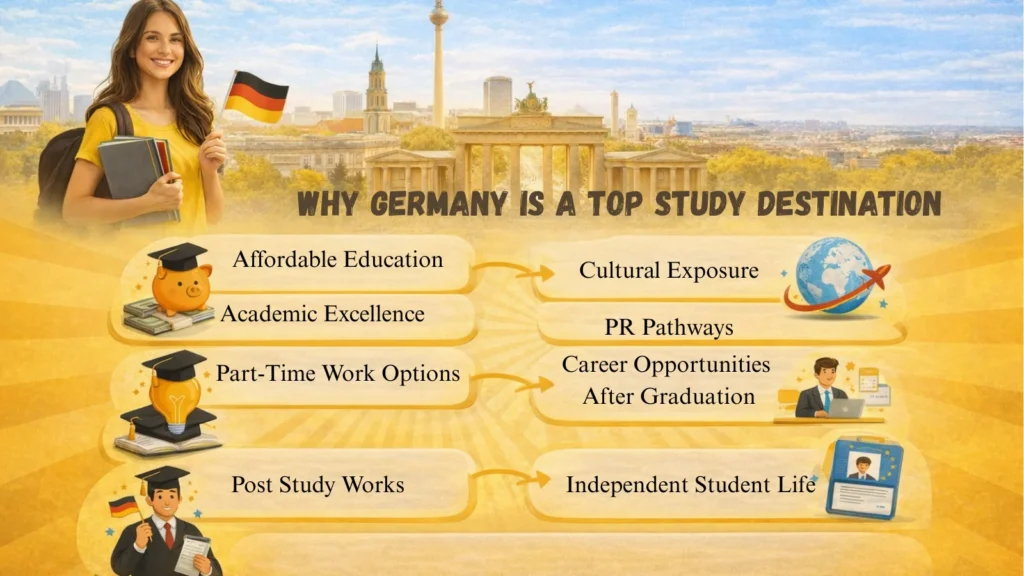
When students walk into a counselling session and ask for a country that balances quality and affordability, Germany is usually one of the first recommendations. Public universities often charge no tuition fees for many programmes, and students primarily pay a modest semester contribution that covers administration and local transport, making the total cost far lower than in destinations like the US or UK. At the same time, several German universities regularly appear in global rankings, offering respected degrees without the heavy financial burden often associated with top‑tier institutions.
Academic Excellence and Learning Environment
From a consultant’s point of view, Germany suits students who want both academic depth and hands‑on exposure. The country hosts more than 400 recognised higher‑education institutions, and together they offer thousands of programmes across engineering, natural sciences, business, social sciences, health, and creative disciplines. Increasingly, international students can choose English-taught programmes at the bachelor’s and master’s levels, which removes the initial language barrier while they gradually build their German skills.
Classes tend to place strong emphasis on critical thinking, independent study, and research skills. Seminar‑style teaching and project work are common, especially at the master’s level, where students often collaborate on case studies or industry‑based assignments. Universities work closely with companies and research institutes, so thesis projects or internships in areas like automotive engineering, renewable energy, logistics, and data science become natural extensions of academic work rather than optional extras.
Cultural Exposure: Living and Growing in Germany
Students in Germany are expected to manage most aspects of daily life independently. University support is limited to academics; accommodation arrangements, address registration, transport use, and compliance with local administrative rules are handled individually. In cities such as Berlin, Munich, Frankfurt, and Hamburg, systems are rule-driven and process-oriented, with little flexibility for personal circumstances. New students often underestimate this at the start.
Over time, operating within these systems becomes routine. Students learn to plan ahead, meet deadlines, and work within clearly defined structures, including multicultural study and work environments. This adjustment is not gradual by design; it is expected early. The outcome is practical independence rather than cultural exposure, and it influences how students function later in professional settings.
Part‑Time Work Options for International Students
For most families, cost planning is not theoretical; it determines whether overseas study is viable at all. In Germany, students are permitted to work within clearly defined annual limits set by immigration rules. This allows many to cover routine expenses such as transport, food, and basic accommodation costs. Employment is typically found in university departments, retail outlets, warehouses, cafés, or entry-level office roles. While this income does not replace primary funding, it reduces financial pressure during the course period.
In many cases, universities also provide on‑campus opportunities such as student assistant roles, lab support positions, or library jobs, which fit naturally around academic schedules. For students in technical or business fields, part‑time roles and internships related to their degree can be especially valuable, helping them build networks and understand German workplace culture long before they graduate. As consultants, the recommendation is always to treat part‑time work as a supplement, not the primary funding source, but it is a significant advantage compared to countries with more restrictive work rules.
Climate and Daily Atmosphere in Germany
For most students coming from warmer countries, Germany’s weather is an adjustment rather than a shock. Summers are generally comfortable, spring and autumn change quickly from sunny to rainy, and winters can be cold but manageable with the right clothing. You experience all four seasons clearly, which also shapes how campuses and cities feel across the year.
In larger cities, the day‑to‑day atmosphere is calm, structured, and rarely chaotic. Public transport is reliable, streets are usually clean, and green spaces are easy to access, which helps students balance study pressure with time outdoors. What many international students notice most is that life is quiet, rules are taken seriously, and people value personal space. Over time, this predictable environment becomes one of the reasons they find it easier to plan their routines and focus on long‑term goals.
Career Opportunities After Studying in Germany
When students ask, “What happens after I finish my degree?”, Germany offers one of the clearest pathways among major study destinations. The country has one of Europe’s strongest economies, with global employers across automotive manufacturing, engineering, IT, finance, logistics, healthcare, and renewable energy operating out of cities and industrial regions across the country. Graduates from German universities, especially those with relevant skills and language competence, are well-positioned for roles that require technical expertise and problem‑solving ability.
Many international graduates benefit from Germany’s post‑study regulations, which typically allow them to extend their stay, often up to 18 months, to search for qualified employment in their field. During this period, they can attend interviews, take up trial roles, and convert internships into full‑time positions. With the right employment contract and salary level, graduates may progress to residence permits that reflect their skilled status, including options linked to the EU Blue Card. This progression makes Germany attractive for students who are thinking not just about a degree, but about long‑term professional and personal stability.
Post‑Study Work and PR Opportunities
Germany’s post-study residence rules are often a deciding factor during counselling discussions. After completing a recognised qualification, graduates are allowed to remain in the country for a defined period solely to look for work. This is not an informal extension; it is a structured status designed to bridge education and employment. Once a graduate secures a role that meets qualification and salary thresholds, the residence status is normally converted to a work permit. With continued employment, language progress, and social security contributions, permanent residence becomes a procedural outcome rather than an exception.
What matters to students is how this works on the ground. Germany is dealing with long-term workforce shortages across engineering, software, healthcare, and technical occupations. Employers are not simply open to international graduates; in many cases, they rely on them. Students who choose courses linked to these sectors, invest early in German language ability, and gain practical exposure through internships move into the labour market with far fewer barriers. In these cases, the shift from student status to employment and long-term residence follows a clear administrative sequence, not a speculative plan.
How Salve Maria Helps You Study in Germany
Making Germany your study destination is a strategic decision, but implementing that decision requires careful guidance at every stage. This is where Salve Maria plays a crucial role. With years of experience in overseas education and strong familiarity with German universities and visa processes, our counsellors help you interpret admission requirements, shortlist suitable programmes, and build an application strategy that reflects your academic record, finances, and long‑term plans. We have branches in Trivandrum, Kottayam, Kochi, Thrissur and Calicut.
From language preparation and documentation to visa filing, pre‑departure briefings, and post‑landing assistance, we support you so that each step is completed correctly and on time for your decision to study in Germany. More importantly, the counselling process focuses on matching Germany’s strengths, excellent education, cultural exposure, part‑time work options, post‑study work rights, and realistic PR pathways to your individual profile. With the right planning and expert guidance from our counsellors, “What Makes Germany the Perfect Study Destination For You?” becomes more than a question; it becomes a clear, achievable roadmap for your future. If you are looking for a study abroad consultant for studying in Germany, contact us or visit our office for personalised guidance.