Study Abroad :  +91 9142552887

Language Division : +91 9142552883

Edit

Salve Maria, a premier study abroad consultancy in Kerala, has a dedicated team from diverse backgrounds that envisions providing honest, transparent, and efficient services to our clients.

Categories
Blogs

Australia Student Visa 2026: New Visa Rules

Are you looking to study in Australia in 2026? Australia remains one of the most desirable destinations for international studies. But let’s be honest—the visa landscape has changed a lot recently.

As a study abroad consultant at Salve Maria Group, I have seen the panic that the new rules for visas have caused. But let me clarify that the new rules are not designed to stop you from getting admission in Australian universities, but to make sure that only genuine students get admission. 

If you are looking to take admissions through the 2026 intake, this blog outlines the changes in the Visa rules. 

What’s New in Australia Student Visa Rules for 2026?

The major change is the complete mindset that has changed, rather than just the rule. The Australian government has moved from the Genuine Temporary Entrant to the Genuine Student (GS) requirement. The focus today is on proving that you are a genuine student who is looking to study to advance your career. 

Imagine you are looking to go to Australia on a visitor visa and then switching to a Student Visa, the new rules will prevent this sort of Visa hopping. 

Updated Eligibility Requirements for International Students

I will now explain the detailed analysis of what has changed in the new Australia Student Visa 2026 rules. 

Language Proficiency

The course content of the Australian universities is quite rigorous. To ensure that you can handle it, the requirements for the knowledge of the English language have been tightened. 

Here are the new requirements for the knowledge of the English language –

  • Student Visa (Subclass 500): You now generally need an IELTS score of 6.0 (or equivalent in PTE), up from the previous 5.5.
  • ELICOS (English courses): The minimum score to package an English course with a degree has also risen to 5.0
  • Graduate Visa (Subclass 485): If you are looking ahead to life after graduation, note that the English requirement for the Temporary Graduate visa is now IELTS 6.5, and the validity of test scores has been reduced to one year.

The eligibility criteria 

International students are expected to fulfil a few conditions to be eligible to study in Australia

  • Verification of enrolment – You should be enrolled for a full-time study programme registered on the CRICOS (Commonwealth Register of Institutions and Courses for Overseas Students)
  • Genuine student statement – The requirement needs you to demonstrate genuine intent to study in Australia.
  • Financial capacity – You should have enough funds, typically around AUD 29,710 per year. 
  • Character and Health – You should also fulfil certain conditions of character and health. 

Documents Required for Australia Student Visa 2026

Getting your paperwork is work half done. Make sure that not a single document is missed out. 

The following checklist should help you find the right list – 

  • Valid Passport: Must be valid for the duration of your stay.
  • Confirmation of Enrolment (CoE): Issued by your university after you accept the offer.
  • Genuine Student (GS) Responses: Clear, evidence-based answers to the new GS questions.
  • Proof of Funds: Bank statements, education loan letters, or scholarship letters showing the required AUD 29,710 + fees
  • English Proficiency Test Results: IELTS/PTE scorecards (no older than 2 years for the student visa).
  • Overseas Student Health Cover (OSHC): Health insurance policy for the entire duration of your course.
  • Academic Transcripts & Certificates: From Class 10 onwards.

Financial Requirements & Proof of Funds in 2026

Australia is an amazing place to live, but the cost of living has gone up considerably in recent times. The visa rules define exactly on this fact exactly. 

For anyone who wants to apply for admission to the 2026 intake, you are expected to show higher savings than in the previous years. The minimum financial capacity requirement has been raised to align with 75% of the national minimum wage.

  • Primary Applicant: You must show access to at least AUD 29,710 (approx. ₹16-17 Lakhs, depending on exchange rates) for living costs alone.
  • Partner/Spouse: An additional AUD 10,394.
  • First Child: An additional AUD 4,449.

Please note that these costs are in addition to the first year’s tuition fees and travel costs (approx. AUD 2,000).

Changes in Student Visa Processing & Priority System

This is the most critical change in 2026. Under the Ministerial Directions 115, visa processing will no longer be based on a “first-come, first-served” basis. 

There is a new traffic light system based on the university or college you choose for admission. If you consider a risky college, your visa can take months to be available. 

Work Rights for International Students in Australia

Australia lets you work, earn and gain experience. That should make Australia one of the most prominent reasons to study in the country. 

However, the work rules in 2026 have been balanced so that your studies remain your primary priority. 

  • During Semesters: You can work up to 48 hours per fortnight (2 weeks). This is a sweet spot—it’s more than the old 40-hour cap, allowing you to work roughly 3 days a week.
  • During Semester Breaks: You have unlimited work rights. You can work full-time to save up for your next semester’s fees or travel.
  • Masters by Research & PhD Students: You have unlimited work rights even during the semester.

Common Reasons for Australia Student Visa Rejection

Remember that even with the high grades, your visa can be rejected. In my experience of working with Salve Maria Group, I have seen that there are several reasons for Visa rejection. 

  • Vague GS Answers: Using generic AI-generated answers for the Genuine Student questions. The case officer wants to know your specific reasons, not a template.
  • Unclear Financials: “Show money” that suddenly appears in an account without a clear source (like a sudden large deposit) raises red flags.
  • Course Irrelevance: Applying for a course that has no logical link to your previous studies or work experience (e.g., a nurse applying for a cookery course).
  • Gap Explanation: Failing to explain gap years with verifiable evidence (work experience letters, pay slips).

Study in Australia with the expertise of Salve Maria Group

Navigating the rules of a student Visa in Australia can feel overwhelming. However, you do not need to do it all alone. Partnering with a reliable and trusted study abroad consultant can help you navigate the exact requirements of a student visa. 

At Salve Maria Group, we don’t just fill out forms; we build careers. With 19 years of legacy and a strong presence through our 10 branches across Kerala, including Trivandrum, Kottayam, Kochi, Thrissur and Calicut. We have successfully guided thousands of students to their dream universities in Australia.  

Ready to start? Contact us today for a free profile assessment.

Categories
Uncategorized

Meet Technological University of Shannon, Ireland on 8th Jan 2026

News & Events

Categories
Blogs

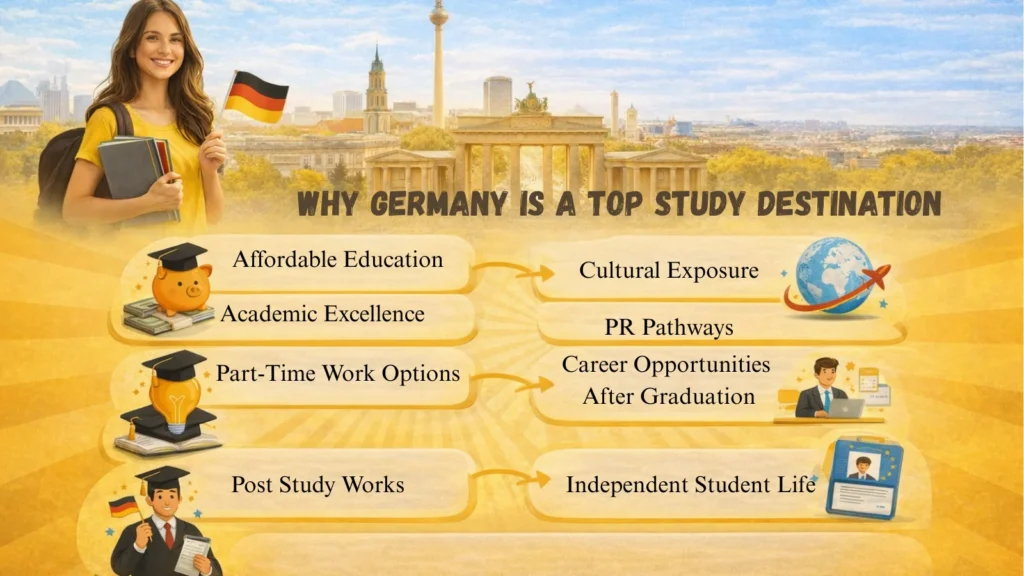
What Makes Germany the Perfect Study Destination For You?

Are you standing at the crossroads of your academic journey, unsure which direction will truly shape your future? Germany might be the path that quietly combines quality education, global exposure, and real career opportunities into one powerful choice. Instead of paying massive tuition fees elsewhere, you can study at high‑ranking universities, build real industry experience, and still afford a comfortable life in a safe, modern country. In this blog, we will look at what truly makes Germany the perfect study destination for you, from world‑class academics to career, culture, and long‑term opportunities.

Why Study in Germany?

When students walk into a counselling session and ask for a country that balances quality and affordability, Germany is usually one of the first recommendations. Public universities often charge no tuition fees for many programmes, and students primarily pay a modest semester contribution that covers administration and local transport, making the total cost far lower than in destinations like the US or UK. At the same time, several German universities regularly appear in global rankings, offering respected degrees without the heavy financial burden often associated with top‑tier institutions.

Academic Excellence and Learning Environment

From a consultant’s point of view, Germany suits students who want both academic depth and hands‑on exposure. The country hosts more than 400 recognised higher‑education institutions, and together they offer thousands of programmes across engineering, natural sciences, business, social sciences, health, and creative disciplines. Increasingly, international students can choose English-taught programmes at the bachelor’s and master’s levels, which removes the initial language barrier while they gradually build their German skills.

Classes tend to place strong emphasis on critical thinking, independent study, and research skills. Seminar‑style teaching and project work are common, especially at the master’s level, where students often collaborate on case studies or industry‑based assignments. Universities work closely with companies and research institutes, so thesis projects or internships in areas like automotive engineering, renewable energy, logistics, and data science become natural extensions of academic work rather than optional extras.

Cultural Exposure: Living and Growing in Germany

Students in Germany are expected to manage most aspects of daily life independently. University support is limited to academics; accommodation arrangements, address registration, transport use, and compliance with local administrative rules are handled individually. In cities such as Berlin, Munich, Frankfurt, and Hamburg, systems are rule-driven and process-oriented, with little flexibility for personal circumstances. New students often underestimate this at the start.

Over time, operating within these systems becomes routine. Students learn to plan ahead, meet deadlines, and work within clearly defined structures, including multicultural study and work environments. This adjustment is not gradual by design; it is expected early. The outcome is practical independence rather than cultural exposure, and it influences how students function later in professional settings.

Part‑Time Work Options for International Students

For most families, cost planning is not theoretical; it determines whether overseas study is viable at all. In Germany, students are permitted to work within clearly defined annual limits set by immigration rules. This allows many to cover routine expenses such as transport, food, and basic accommodation costs. Employment is typically found in university departments, retail outlets, warehouses, cafés, or entry-level office roles. While this income does not replace primary funding, it reduces financial pressure during the course period.

In many cases, universities also provide on‑campus opportunities such as student assistant roles, lab support positions, or library jobs, which fit naturally around academic schedules. For students in technical or business fields, part‑time roles and internships related to their degree can be especially valuable, helping them build networks and understand German workplace culture long before they graduate. As consultants, the recommendation is always to treat part‑time work as a supplement, not the primary funding source, but it is a significant advantage compared to countries with more restrictive work rules.

Climate and Daily Atmosphere in Germany

For most students coming from warmer countries, Germany’s weather is an adjustment rather than a shock. Summers are generally comfortable, spring and autumn change quickly from sunny to rainy, and winters can be cold but manageable with the right clothing. You experience all four seasons clearly, which also shapes how campuses and cities feel across the year.

In larger cities, the day‑to‑day atmosphere is calm, structured, and rarely chaotic. Public transport is reliable, streets are usually clean, and green spaces are easy to access, which helps students balance study pressure with time outdoors. What many international students notice most is that life is quiet, rules are taken seriously, and people value personal space. Over time, this predictable environment becomes one of the reasons they find it easier to plan their routines and focus on long‑term goals.

Career Opportunities After Studying in Germany

When students ask, “What happens after I finish my degree?”, Germany offers one of the clearest pathways among major study destinations. The country has one of Europe’s strongest economies, with global employers across automotive manufacturing, engineering, IT, finance, logistics, healthcare, and renewable energy operating out of cities and industrial regions across the country. Graduates from German universities, especially those with relevant skills and language competence, are well-positioned for roles that require technical expertise and problem‑solving ability.

Many international graduates benefit from Germany’s post‑study regulations, which typically allow them to extend their stay, often up to 18 months, to search for qualified employment in their field. During this period, they can attend interviews, take up trial roles, and convert internships into full‑time positions. With the right employment contract and salary level, graduates may progress to residence permits that reflect their skilled status, including options linked to the EU Blue Card. This progression makes Germany attractive for students who are thinking not just about a degree, but about long‑term professional and personal stability.

Post‑Study Work and PR Opportunities

Germany’s post-study residence rules are often a deciding factor during counselling discussions. After completing a recognised qualification, graduates are allowed to remain in the country for a defined period solely to look for work. This is not an informal extension; it is a structured status designed to bridge education and employment. Once a graduate secures a role that meets qualification and salary thresholds, the residence status is normally converted to a work permit. With continued employment, language progress, and social security contributions, permanent residence becomes a procedural outcome rather than an exception.

What matters to students is how this works on the ground. Germany is dealing with long-term workforce shortages across engineering, software, healthcare, and technical occupations. Employers are not simply open to international graduates; in many cases, they rely on them. Students who choose courses linked to these sectors, invest early in German language ability, and gain practical exposure through internships move into the labour market with far fewer barriers. In these cases, the shift from student status to employment and long-term residence follows a clear administrative sequence, not a speculative plan.

How Salve Maria Helps You Study in Germany

Making Germany your study destination is a strategic decision, but implementing that decision requires careful guidance at every stage. This is where Salve Maria plays a crucial role. With years of experience in overseas education and strong familiarity with German universities and visa processes, our counsellors help you interpret admission requirements, shortlist suitable programmes, and build an application strategy that reflects your academic record, finances, and long‑term plans. We have branches in Trivandrum, Kottayam, Kochi, Thrissur and Calicut.

From language preparation and documentation to visa filing, pre‑departure briefings, and post‑landing assistance, we support you so that each step is completed correctly and on time for your decision to study in Germany. More importantly, the counselling process focuses on matching Germany’s strengths, excellent education, cultural exposure, part‑time work options, post‑study work rights, and realistic PR pathways to your individual profile. With the right planning and expert guidance from our counsellors, “What Makes Germany the Perfect Study Destination For You?” becomes more than a question; it becomes a clear, achievable roadmap for your future. If you are looking for a study abroad consultant for studying in Germany, contact us or visit our office for personalised guidance.

Categories
Blogs

Which Is the Best Study Abroad Consultant in Kerala?

Which Is the Best Study Abroad Consultant in Kerala?

An 18-Year Insider Perspective on What Truly Matters

Every year, thousands of students and parents across Kerala search for one answer:

“Which is the best study abroad consultant in Kerala?”

It is a valid question. Studying abroad is one of the most important financial and life decisions a family makes. A wrong decision can cost years of effort, lakhs of rupees, and emotional stress. A right decision, on the other hand, can open doors to quality education, global exposure, and long-term career growth.

However, based on 18 years of experience in the study abroad landscape in Kerala, one thing must be said upfront — the question itself is slightly flawed.

There is no single study abroad consultant in Kerala who is “best” for everyone.

And believing that there is one universal “best” is often where students begin making mistakes.

This article is written to explain why that is the case, what actually defines a good consultant, and how students and parents can make informed, realistic decisions — without falling for half-truths, marketing gimmicks, or unrealistic promises.

Is There a Single “Best” Study Abroad Consultant in Kerala?

The honest answer is: No.

Students differ widely in:

  • Academic background


  • Financial capacity


  • Country preferences


  • Long-term career goals


  • Risk tolerance


  • Family expectations


A consultant who is excellent for a nursing professional may not be the right choice for a student after 12th. A consultant who works well for high-budget UK or Australia profiles may not suit low-budget students seeking practical pathways.

One-size-fits-all counseling does not work in overseas education.

What truly matters is whether a consultant:

  • Understands your profile


  • Gives advice that prioritizes your future


  • Is transparent about costs, risks, and outcomes


  • Is willing to say no when something is not right for you


From our experience, the best consultant is not the one who promises the most, but the one who explains the realities clearly — even when those realities are uncomfortable.

What Does “Best” Actually Mean in Study Abroad Counseling?

Over the years, certain clear markers consistently separate ethical, student-centric consultants from commission-driven ones. Based on experience, the following five pillars define quality counseling.

1. Ethical Counseling Over Commissions

Not every university, country, or intake is right for every student.

An ethical consultant:

  • Recommends universities based on academic fit and outcomes


  • Does not push a country simply because it offers higher commissions


  • Is willing to explain why a popular destination may not suit a particular student


Unfortunately, students are sometimes encouraged toward low-scope countries or non-EU destinations with the hope of jobs or long-term settlement — promises that may not align with reality.

Ethical counseling means long-term thinking, not short-term gains.

2. Complete Transparency in Fees

Transparency is one of the biggest pain points in the industry.

Students and parents should clearly understand:

  • Tuition fees


  • Application fees


  • Visa fees


  • Living expenses


  • Payment timelines


  • Currency conversion details


Some unethical practices observed in the industry include:

  • Charging registration fees (often ₹500–₹1,500) purely as “easy money”


  • Quoting tuition fees at slightly inflated exchange rates


  • Using third-party payment vendors without clear disclosure


For example, even a difference of ₹2–₹3 per pound on a £15,000 tuition fee can result in ₹30,000 extra per student, often without the family realizing it.

Best practice:
Always pay tuition fees directly to the institution whenever possible, and ask for written clarity on all payments.

3. Focus on University Quality, Not Just Country Names

The country alone does not determine success — the institution and course quality matter far more.

A responsible consultant looks at:

  • Accreditation


  • Campus facilities


  • Employability outcomes


  • Industry exposure


  • Long-term academic value


Pushing students into institutions with limited recognition simply because they are cheaper or easier to process can lead to disappointment later, especially when job opportunities are limited.

4. Personalized Guidance — Not Template Counseling

Every student’s journey is different.

Good consultants take time to understand:

  • Academic strengths and weaknesses


  • Career aspirations


  • Financial realities


  • Family expectations


Personalized counseling often means not agreeing blindly with the student, but guiding them toward realistic alternatives that still meet their goals.

5. Honest Communication About Jobs, PR, and Reality

Perhaps the most important pillar — and the most ignored.

Studying abroad:

  • Does not guarantee a job


  • Does not guarantee permanent residency (PR)


  • Does not eliminate financial responsibility


PR policies are controlled by governments and change frequently. Many changes are not foreseeable at the time of recruitment. Students must be prepared for uncertainty and competition.

A good consultant clearly explains this before the student commits.

The Reality of Studying Abroad: What Students and Parents Must Understand

One of the most important messages parents and students need to hear is this:

Getting an admission is only the beginning — not the end goal.

Education Comes First

The primary objective of sending a student abroad should be:

  • Completing the degree successfully


  • Gaining relevant knowledge and skills


  • Becoming employable in the chosen field


Expecting students to fully repay education loans through part-time jobs during studies is unrealistic and creates unnecessary pressure.

The Truth About Part-Time Work

Part-time jobs:

  • Are meant to support daily living expenses


  • Rarely cover tuition fees or large financial commitments


  • May be limited by visa rules and academic workload


Students may or may not be entitled to work full-time during studies, and regulations vary by country.

Families must ensure adequate funds are available to support the student throughout the course duration.

Jobs and PR Are Not Automatic

Employment after studies depends on:

  • Academic performance


  • Skill relevance


  • Language proficiency


  • Networking


  • Market demand


  • Immigration policies at that time


PR pathways are policy-driven, not consultant-driven.

Students who complete their courses successfully and secure skilled employment stand a far better chance than those who focus solely on short-term earnings.

Common Myths Among Kerala Students

Myth 1: Trusted Brand =Higher Cost

A well-established study abroad brand offers greater reliability and peace of mind and can offer competitive rates on account of the established relationships and scale of economies due to their larger presence.Established study-abroad providers bring stability, trusted support systems and fewer risks.

In Short” Trusted brand. Proven safety. Confident choice.

Well-known study abroad organizations bring the advantage of experience. With dedicated support teams, clear procedures, and a global network of partners, students benefit from a safer and more secure learning experience abroad.

Myth 2: IELTS Score Decides Everything

While language proficiency is important, admissions are based on:

  • Academic profile


  • Course relevance


  • Statement of purpose


  • Overall consistency


A moderate IELTS score does not mean the end of opportunities.

Myth 3: Studying in Europe Automatically Guarantees Jobs

While a degree alone does not automatically secure employment, studying in Europe offers significant advantages for your future career. European universities are known for high-quality education, international exposure, practical learning, and strong connections with industry, all of which improve your employability.Studying in Europe does not automatically guarantee employment—but it gives you a head start. With international experience, practical skills, and global networking opportunities, students are better positioned to secure rewarding careers worldwide.Associating with an experienced consultancy like Salve Maria can get you wider access to top universities and 

Myth 4: Low-Cost Countries Offer Easy Futures

Lower tuition does not always mean better value.

If long-term career prospects are limited, the initial savings may not justify the outcome.

A Real-World Case Study: Ethical Guidance in Practice

A student approached us with a clear aspiration — a UK business degree.
However, the cost of studying on the UK campus was beyond her financial capacity.

Instead of forcing an unaffordable option or redirecting her to a low-scope alternative, we suggested a Dubai campus of the same UK university:

  • Lower tuition and living costs


  • Same curriculum


  • Same degree certificate


  • Better financial sustainability


The decision allowed the student to achieve her academic goal without unnecessary financial strain.

This is what student-centric counseling looks like — adapting the pathway without compromising the outcome.

Wrongful Practices Students Should Be Aware Of

Over the years, we have observed certain industry practices that students should approach with caution:

  • Charging unnecessary registration fees


  • Inflated tuition payment conversions


  • Promising jobs or PR as guarantees


  • Promoting countries with limited future scope


  • Hiding bitter facts to avoid losing clients


Students should choose consultants who:

  • Present facts, not fantasies


  • Are willing to challenge unrealistic expectations


  • Provide written clarity on processes and costs


Sweet talk may feel comforting initially, but facts protect futures.

Which Type of Consultant Is Best for You?

Instead of asking who is the best consultant, students should ask which consultant fits their profile best.

  • Nursing professionals: Look for consultants experienced in healthcare pathways and licensing requirements


  • Students after 12th: Focus on academic foundations and long-term progression options


  • Graduates: Course relevance and employability outcomes are key


  • IT professionals: Industry exposure and skill alignment matter more than country names


  • Low-budget students: Transparency and realistic pathways are essential


Where Experience Makes a Difference

Over nearly two decades, guiding students across destinations such as:

  • UK


  • Germany


  • Australia


  • Ireland


  • New Zealand


  • Dubai


  • France


has reinforced one belief: truthful counseling builds long-term success.

A transparent, student-centric approach may not always be the easiest — but it is the most sustainable.

Final Answer: So, Which Is the Best Study Abroad Consultant in Kerala?

The best study abroad consultant in Kerala is not the one who promises the fastest admission, the cheapest option, or guaranteed outcomes.

It is the one who:

  • Understands your profile deeply


  • Explains risks as clearly as opportunities


  • Prioritizes education over commissions


  • Respects your financial reality


  • Thinks beyond admission letters


Choose facts over fantasies. Choose guidance over guarantees.

That decision will matter far more than any brand name.

Categories
Blogs

Who Should Ideally Apply for Low Cost Study Destination


Choosing a low-cost country for studying abroad can be a smart move for many Indian students, especially when budget is a major concern. Here’s who should ideally opt for low-cost countries and what types of students benefit most:

✅ Students Who Should Opt for Low-Cost Countries

1. Students With Limited Financial Resources

If you want an international degree but cannot afford expensive destinations like the US, UK, Canada, or Australia, then low-cost countries are a great fit.
Tuition + living costs in such countries can be 60–80% cheaper.

2. Students Not Planning for Post-Study Stay in High-Paying Countries

If your goal is mainly:

  • gaining global exposure,

  • building a strong academic profile,

  • earning an international degree,

…without necessarily settling abroad permanently, then affordable countries are ideal.

3. Students Targeting Specialized Courses at Lower Fees

Countries like Germany, Poland, Latvia, and Malaysia offer:

  • Engineering

  • IT & Computer Science

  • Business

  • MBBS / Healthcare

  • Hospitality & Tourism
    …at significantly lower costs.

If the same course in the US/UK is beyond budget, low-cost nations are a great alternative.

4. Students Comfortable With Diverse Cultures and Learning Environments

Low-cost countries are often:

  • multicultural,

  • non-English-speaking,

  • more adaptable environments.

Students who are open-minded and flexible thrive best.

5. Students Looking for Part-Time Work Options to Support Costs

Countries like:

  • Germany

  • Poland

  • Czech Republic

  • Malaysia
    allow students to work part-time and reduce living costs.

If you plan to fund part of your stay through part-time work, these locations are suitable.


6. Students Who Value Safety and Quality Over “Brand Name” Countries

Many low-cost countries offer:

  • Strong academic quality

  • Safe student environments

  • Good rankings for specific programs

For students who prioritize value for money, these countries are ideal.

⭐ Popular Low-Cost Countries for Indian Students

  • Germany (public universities with near-zero tuition)

  • Poland

  • Czech Republic

  • Latvia

  • Lithuania

  • Hungary

  • Malaysia

  • Thailand

  • Turkey

  • Philippines (popular for MBBS)

✔ Summary

Choose a low-cost country if you are:

  • Budget conscious

  • Willing to explore part-time work opportunities
  • Want quality education without debt
  • Are flexible about location and culture
  • Value return on investment (ROI) over brand prestige


Categories
International Education News

Why Germany is becoming a preferred study abroad destination for Indian students

Germany is attracting Indian and international students in 2025 with tuition-free universities, new visa rules, scholarships, and career opportunities, making it one of the most sought-after global study abroad destinations.

With its world-class institutions, a vibrant academic environment and the policy changes in traditional destinations, Germany emerges as one of the preferred destinations for international students: With rich cultural heritage, advanced research, and experiential learning, it provides an education experience beyond the confines of a classroom.

German universities like TU Munich and Heidelberg University offer tuition-free or low-cost education to the local and international students.


According to the University Living European Student Landscape Report, Germany hosts 3.43 million students, of which 39,600 are Indians, and 422,188 international students.

RECENT AND NOTABLES POLICY CHANGES

From September 1, 2024, the financial proof requirement for student visas increased to 11,904 per year (up from 11,208) to reflect rising living costs. Starting February 17, 2025, all student visa applications must be filed through Germany’s new Consular Services Portal (digital-di.de), replacing older submission methods.

Additionally, from July 1, 2025, the long-standing remonstration process for visa rejections will be discontinued. Instead, applicants whose visas are refused will need to pursue a formal legal appeal. In terms of employment, from January 1, 2025, Germany’s legal minimum wage will rise to 12.82 per hour (up from 12.41).

At the same time, the mini-job salary threshold, the maximum monthly earnings allowed under Germany’s tax-free mini-job category, will increase from 538 to 556 per month.


WHY STUDY IN GERMANY

  • No tuition fees for most undergrad programmes: Most German public universities charge little to no tuition fees for most undergrad programs and thus reducing the financial burden on international students.
  • Strong career prospects: Demand for skilled professionals in Germany, particularly for its innovative research opportunities, especially in fields like engineering, natural sciences, and technology.
  • Post-study work visa: Graduates can stay for up to 18 months after completing their studies to find employment, a major draw for students seeking global career prospects.
  • Scholarships and funding: Scholarships in Germany ease financial burdens and promote academic excellence. Programmes like DAAD, Erasmus+ and Heinrich Bll provide generous funding, fostering diversity and cross-border collaboration for both local and international students, including those from India.

COST OF LIVING IN GERMANY

While larger German cities are more expensive, smaller towns offer significantly lower living expenses, making it an attractive choice for budget-conscious students.


Facebook
Facebook
Call Now Button