Over the last few years, the number of Indian students pursuing higher education overseas has steadily risen. Today, studying abroad has become a strategic decision because it offers global exposure, better learning opportunities, and stronger career prospects.
If you are a student who is looking forward to pursuing higher studies abroad, the road ahead can be both exciting and challenging. With proper planning, you can navigate the entire process confidently. However, one of the most crucial steps in this journey is compiling all the required documents, as they form the backbone of your application.
To make sure you succeed in this process, we have compiled the list of all the documents required to study abroad in 2026. Additionally, we will also take a look at common mistakes people make during the process and how to avoid them so that you can increase your chances of success.
Essential Documents for International Studies in 2026
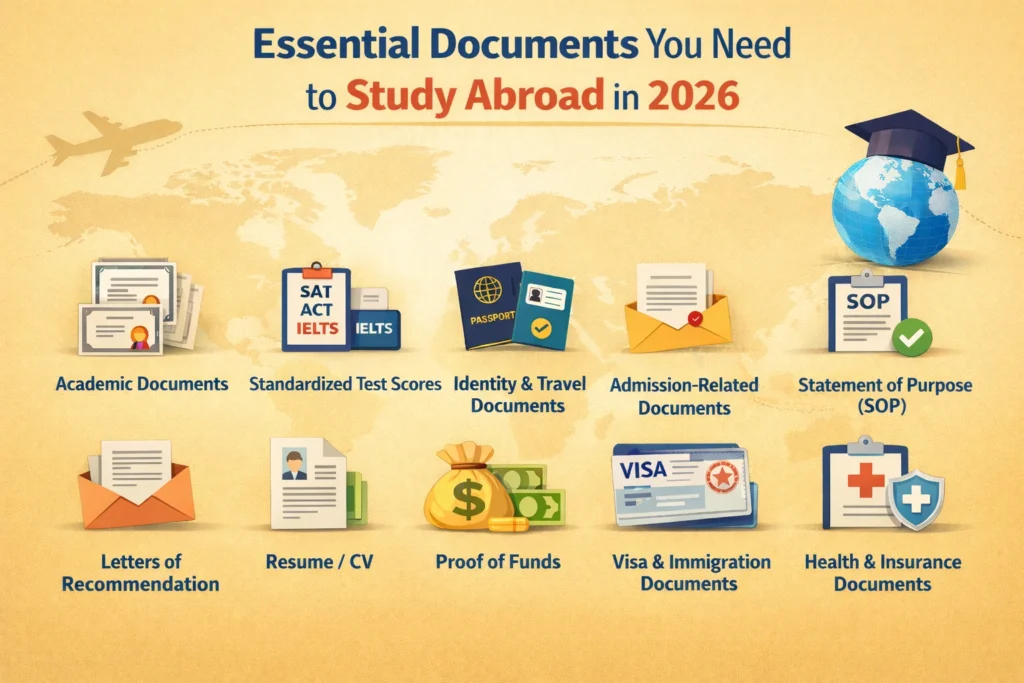
Preparing the appropriate documents is a crucial step in the study abroad journey. Universities across the world require a set of paperwork to verify your credentials and check whether you are eligible to study there. To help you speed through this process, we have outlined the right list of documents required:
1. Academic Documents
Your academic records form the foundation of your study abroad application. These documents help universities evaluate your academic performance, subject knowledge, and readiness for the chosen program. You will generally be required to submit:
- Class 10 and 12 mark sheets and certificates, for substantiating your academic history.
- Undergraduate or previous degree transcripts and certificates, as per the course or program you want to study.
- School or college leaving/transfer certificates.
- Research papers, project reports, or dissertation documents for postgraduate or PhD applicants
- Certified translations of documents if the originals are not in English
Make sure that all these documents are accurate, complete, and officially issued. Any discrepancies or mismatched information can negatively impact admission decisions and set you back.
2. Standardized Test Scores
Most universities abroad require standardized test scores to assess one’s academic skills and language proficiency. These scores indicate that students can cope with the academic demands of the particular education system. Common tests include:
- English language proficiency tests such as IELTS (International English Language Testing System), TOEFL (Test of English as a Foreign Language), and PTE (Pearson Test of English).
- Undergraduate entrance exams like the SAT or ACT are primarily for universities in the US.
- Graduate-level entrance tests, such as the GRE for STEM or master’s programs.
- Business school entrance exams, like the GMAT for MBA applicants.
Verify whether the test scores are valid at the time of application. This is because many scores have expiry periods and need to be retaken if expired.
3. Identity and Travel Documents
Identity and travel documents confirm your nationality and legal ability to travel and reside in another country. These documents typically comprise:
- A valid passport is usually required to be valid for at least six months beyond your planned stay.
- Passport-size photographs that match the specific university or embassy guidelines.
- National identity proof, if requested by certain institutions or visa authorities
As your passport details must match all application forms, it is important to verify personal information carefully while applying.
4. Admission-Related Documents
Once you receive an offer from a university, additional documents become essential for confirming your enrollment and initiating visa procedures. These usually include:
- The university offers a letter of acceptance or a conditional acceptance letter.
- Proof of tuition fee payment.
- Country-specific student forms, such as the I-20 for the USA or CAS for the UK
These documents can officially confirm your admission status, making them mandatory for student visa applications.
5. Statement of Purpose (SOP)
The Statement of Purpose is an important document in the application process. This document allows you to explain your academic journey, career goals, and reasons for choosing a particular course and university. A strong SOP will outline how the program aligns with your long-term plans as well as demonstrate your motivation to study abroad. The SOP is often used by admissions committees to tell the difference between applicants who have similar academic backgrounds.
6. Letters of Recommendation (LORs)
A letter of Recommendation offers an external perspective on your academic abilities, character, and potential. Most universities require two or three LORs from professors, academic mentors, or employers. LORs need to highlight your strengths, work ethic, and suitability for the program you want to apply for.
7. Resume
A resume or CV is important in the case of postgraduate, MBA, and research programs. This document offers a brief overview of your academic and professional background. Your CV should typically include:
- Academic qualifications and achievements.
- Relevant work experience.
- Internships, projects, and research work.
- Certifications, workshops, and extracurricular activities related to your field.
A well-crafted CV can show the universities your overall profile, going beyond the reliance on grades.
8. Proof of Funds
Financial documents are mandatory for both university admission and visa approval. Visa authorities require proof that you can cover tuition fees and living expenses throughout your study period abroad. Key financial documents include:
- Bank statements, usually for the last six months, showing sufficient funds
- Education loan sanction letter.
- Affidavit of support or sponsorship letter, along with sponsor documents.
- Income Tax Returns (ITRs)
- Fixed deposit or other proof of investment.
These documents demonstrate financial stability and eliminate the risk of visa rejection.
9. Visa and Immigration Documents
Each country has specific visa requirements, but most student visa applications require a standard set of documents, including:
- A completed student visa application form
- Proof of financial capability
- Original academic documents
- Language test scores
- Offer letter from the university
- Visa fee payment receipts
Additional documents, such as medical certificates or police clearance certificates, may sometimes be required.
10. Health and Insurance Documents
Many countries require proof that international students are medically fit and adequately insured. It is a legal requirement for many countries. Common documents include:
- A medical fitness certificate from an approved medical practitioner
- Vaccination records, if mandated by the destination country
- A health insurance policy covering the entire duration of the study abroad
The policy requirements vary as per the country, so it is important to consult with the authorities or partners before proceeding.
Common Documentation Mistakes to Avoid in 2026
Now that we’ve checked all the required documents, we’ll look at common mistakes. Even with the right and updated information, a tiny mistake can lead to delays and even the rejection of your application:
Incomplete Portfolios: Submitting applications without all required documents can increase the chances of success. A missing SOP or unexplained academic gaps are frequent causes of issues. We recommend using university checklists and cross-checking before submission.
Inaccurate Personal Details: Verify that all the submitted details match across your passport, application forms, SOP, and academic credentials. Even simple, minor variations in name spelling or wrong date formats can impact your application.
Late Preparation: Start documentation preparation at least 6 to 12 months before your intended term. Waiting until the last minute can result in rushed processes, missing bank statements, or delayed test score reports.
Country-Specific Requirements: It is important to note that visa and university requirements vary by destination. For example, Canada may require a Guaranteed Investment Certificate (GIC), while the UK needs a CAS (Confirmation of Acceptance for Studies). We recommend visiting the official immigration sites for updates.
Use of Fake or Misleading Documents: Use of Fake or Misleading Documents: Arranging finances through fake bank statements, inflated balances, or non-genuine asset documents is considered a serious violation of immigration rules. Similarly, submitting fake academic documents, forged experience certificates, fabricated work histories, or manipulated test scores can lead to immediate application or Visa rejection.
Start Your Study Abroad Journey with Salve Maria
Applying to study abroad is a major life decision. However, managing the documentation process can be arduous and complex. This is why Salve Maria offers comprehensive guidance on the documents required to study abroad in 2026. Our team of professionals will assist you in preparing every document with accuracy and care. Salve Maria has 19 years of experience and 10 branches throughout Kerala, including Trivandrum, Kottayam, Pala, Kochi, Thiruvalla, Calicut, and more. By supporting you at every stage of the journey, Salve Maria will check compliance and timeliness to increase your chances of success.
Partner with Salve Maria and let us help you start your international education with confidence. Contact us to set a consultation with our study abroad experts today!